HELICAL PIER FOUNDATION STABILIZATION
Deep Foundation Support for Existing Structures and New Construction
When soils near the surface cannot adequately support a structure, the solution may require transferring structural loads deeper into the ground.
Helical piers are steel foundation supports designed to reach suitable load bearing soils and provide deep foundation support for residential, commercial, and other structural applications.
At Priority Foundation Repair, helical piers are one of several stabilization and underpinning methods available to us.
Our approach begins with the structure, not the product.
The repair should fit the structure, not the other way around.
WHAT IS A HELICAL PIER?
A helical pier is a steel shaft equipped with one or more engineered helix shaped bearing plates, commonly referred to as flights.
The pier is mechanically rotated into the soil using a hydraulic drive head mounted to installation equipment or, where appropriate, a portable handheld installation system. Additional shaft sections are added as necessary until the required installation criteria are achieved.
The ability to use different installation equipment can make helical piers particularly useful on projects with limited access. Depending on the project conditions and required pier configuration, helical piers may be installed outside a structure, within crawl spaces, or in certain interior locations where larger equipment cannot operate.
For existing structures, the installed pier can be connected to the foundation using a steel bracket, allowing structural loads to be transferred through inadequate soils and into stronger supporting soils below.
Helical piers can also be incorporated into certain new construction and specialty structural applications where deep foundation support is required.
WHEN ARE HELICAL PIERS USED?
Helical piers can be used for a wide range of structural applications, including:
- Foundation settlement
- Residential underpinning
- Commercial foundation stabilization
- New construction foundations
- Building additions
- Interior foundation stabilization
- Crawl space structural support
- Porches and structural columns
- Equipment pads and structural supports
- Limited access installation areas
- Projects where excavation needs to be minimized
- Locations where existing structural weight is not sufficient for push pier installation
- Engineered deep foundation applications
The appropriate system depends on the structure, loads, soil conditions, foundation configuration, access, and project requirements.
Seeing a foundation crack does not automatically mean a property needs piers. The first step is understanding why the movement is occurring.
HOW PFR APPROACHES HELICAL PIER PROJECTS
Understand What the Pier Is Supporting
A helical pier is only one component of a structural repair.
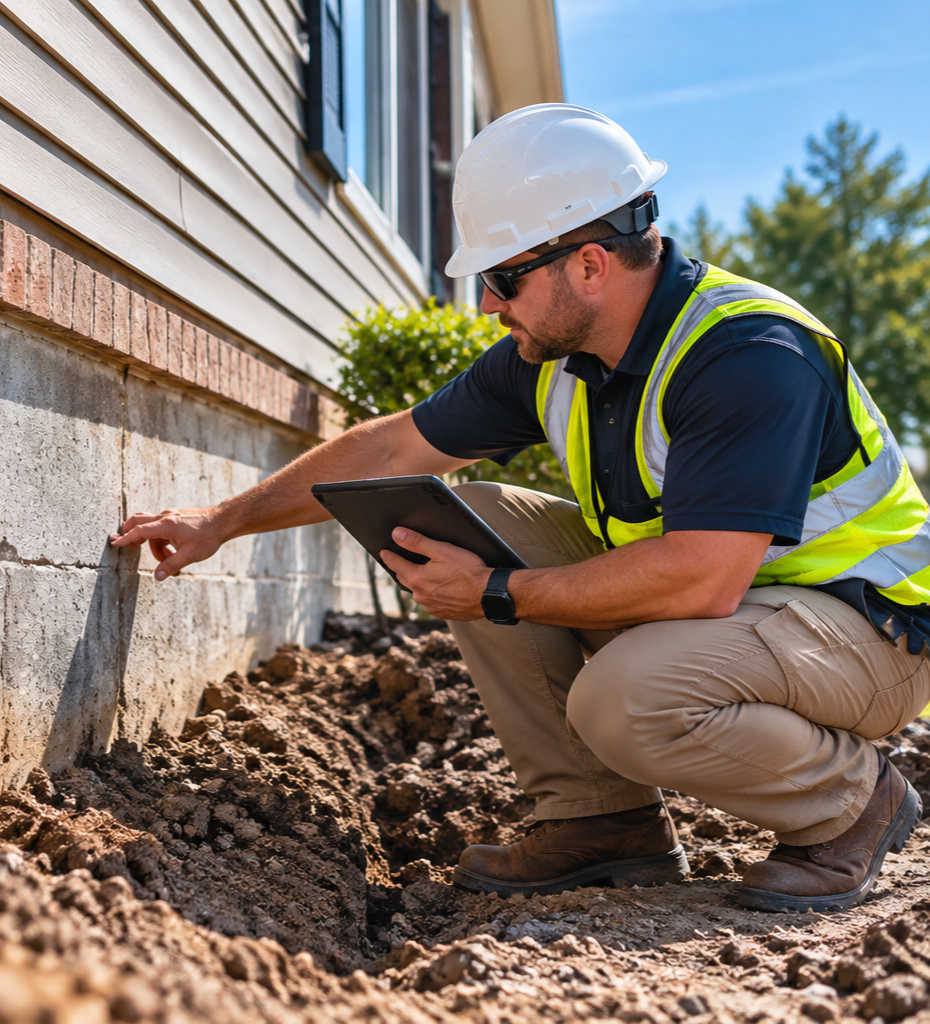
Before determining where support is needed, PFR evaluates the visible and reasonably accessible structural conditions and looks at the overall pattern of movement rather than reacting to an individual crack or symptom.
Depending on the project, that may include foundation configuration, structural framing, floor elevations, masonry movement, drainage conditions, soil information, existing loads, and previous repairs.
For more complex projects, structural and geotechnical engineering may be used to establish design loads, pier locations, configurations, installation requirements, and other project specific criteria.
PFR works alongside licensed structural and geotechnical professionals when engineering is required.
Understand the structure. Identify the cause. Build the right repair.
HELICAL PIERS VS PUSH PIERS
Both systems can provide deep foundation support, but they accomplish it differently.

Helical Piers
Helical piers are mechanically rotated into the soil and do not require the weight of an existing structure for installation.
Different installation equipment can also make them suitable for certain limited access and interior applications.

Push Piers
Push piers are hydraulically advanced using the weight of the existing structure as resistance. They are commonly used for underpinning existing structures experiencing settlement.
There are projects where either system may be appropriate and others where the structure, soils, loads, access, or engineering requirements make one better suited than the other.
PFR installs both because we believe the repair method should be selected for the structure, rather
than selecting the structure for the repair method.
RESIDENTIAL AND COMMERCIAL HELICAL PIER INSTALLATION
PFR performs helical pier and helical pile installations for both residential and commercial structures.
Our work can range from localized residential foundation settlement and limited access interior installations to larger engineered underpinning and deep foundation projects.
For complex projects, PFR can coordinate with property owners, general contractors, structural engineers, geotechnical engineers, architects, property managers, and other project professionals.
Our experience performing structural repairs beyond pier installation also gives our team a broader understanding of how foundations, masonry, framing, floor systems, and other structural components interact when movement occurs.
A DIFFERENT APPROACH TO FOUNDATION REPAIR
PFR is not built around one foundation repair system.
We are a specialty structural repair contractor.
Our inspectors evaluate structures to understand what is happening and why. Our production teams then experience those structures from the inside out while performing the repairs.
Both sides have knowledge the other side needs.
Sharing that field experience helps us continually improve how we evaluate structures, develop repair scopes, coordinate with engineers, document installations, and perform the work.
With helical piers, our responsibility is not simply installing steel into the ground.
Our responsibility is understanding what that pier is supporting and why it needs to be there.
NEED DEEP FOUNDATION SUPPORT?
Whether you are dealing with settlement at an existing home, a commercial foundation problem, an interior stabilization project, or an engineered project requiring deep foundation support, PFR can evaluate the structure and help determine the
appropriate next step.
Priority Foundation Repair serves Virginia Beach, Chesapeake, Norfolk, Suffolk, Portsmouth, Hampton, Newport News, Williamsburg, and surrounding areas.

Priority Foundation Repair
Built to Solve Structural Problems